



|
|
|
|
|
|
|
|
|
|
||||||
| |||||
|
|
||||||||||||||||||||||||||||||||||||||||||
|
|
Emperor and ruler of Ethiopia since 1930, Haile Selassie dealt inadequately with the lasting drought in his country leading to a gradual coup that began in February 1974. This culminated in September with his ouster by a military junta, the Derg. The repressive regime that followed slaughtered hundreds of thousands and fueled subsequent unrest, birthing a nation torn by violent uprisings, continued drought, and a massive number of refugees.
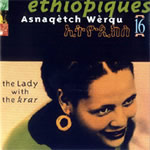
During this time, artists in Ethiopia were often forced underground to perform or create beneath the climate of repression. Once again the meticulous French label Buda Musique deliver, culling these 22 songs from “The Lady With The Krar” from their previously-acquired Kaifa Records archive (1973-77), unearthing yet another gem from Ethiopia¹s rich musical heritage. The first 12 songs on Volume 16 of the heralded Ethiopiques series featuring Asnaqetch Werqu were released during the beginning of the revolutionary disorder and banned soon after as records were taken off the shelves.
Werqu was an orphan who went on to become the first actress to appear on the Ethiopian stage. Interestingly, it was her musical talent and not her career in the National Theatre that earned her fame. She was a “public speaker,” with her sole accompaniment being the Ethiopian krar. Belonging to the harp family and employing an almost circular soundbox, it was considered the instrument of the devil.
The 22 tracks eschew the devil, but are wrought with personal demons. Each song is like a dusty portrait of an aching woman. With much of the album dedicated to loneliness, longing and revenge, pretty themes take cover in dark corners. On “Tezeta,” Werqu shrieks in her native tongue “Thank God the bed is not quiet,” adding later “I far prefer your body all in pieces/ as if pulverized.” On “Gubelye” she cries, “your cruelty is limitless” and warns, “friends or enemies end up as corpses.” Her gorgeous voice is nothing short of trance-inducing, fluttering passionately above the loping plink of the krar.
A member of the lyre family, the krar was the favorite instrument of the “azmari” or musician class. An azmari was often invited to perform at private parties where they would improvise lyrics based on a theme suggested by the host. Dubbed “poetic jousting,” it was dedicated to the art of wit and comparable to a freestyle battle in hip-hop, with artists lauded for poignancy, sarcasm, use of puns and imagery. Werqu weaves objects that she might come across while performing at a home (red peppers, iron pots, lemons) into her epic stories of redemption (“This is why I must give birth / To be rid of him”). She is widely recognized as the last great performer of this tradition.
The packaging, as with all the Ethiopiques releases is tops, with extensive liner notes in both French and English, and a number of photographs of Werqu at different stages of her career.
It turns out this is exactly what the matter-of-fact title suggests: a lady and a krar, haunting in its simplicity. By Jake O'Connell
|
||||||||||||||||||||||||||||||||||||||||
|
||||||||||||||||||||||||||||||||||||||||||
| |||||


 View all articles by Jake O'Connell