|
|
 |
Dusted Reviews
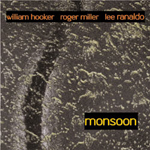
Artist: William Hooker/Roger Miller/Lee Ranaldo Album: Out Trios Volume One: Monsoon Label: Atavistic Review date: Feb. 15, 2004 |
|
|
|
|
Monsoon, the premier release on Atavistic’s Out Trios series, is a first in more ways than one. Not only is it the inaugural Out Trios disc, but Monsoon is also the first recorded meeting of Roger Miller with either Lee Ranaldo or William Hooker. Miller is best known as the guitarist of Mission of Burma, and while he’s no stranger to improvised music, his experience with the downtown NYC improv scene is limited. The latter two musicians have collaborated before as a duo on Envisioning, and also in trio settings with Zeena Parkins and Christian Marclay, on Gift of Tongues and Boquet, respectively. This set was recorded in Spring 2002 at The Knitting Factory in New York, with Hooker playing drums, Ranaldo on guitar and “small devices,” and Miller on bass with effects, loops, and keyboard samples.
Hooker’s playing, more often than not, is a manifestation of crowded, cathartic expulsion of almost poetic proportions. It’s hard to doubt his emotion, musical integrity or verve, but a question arises: how does one such as Hooker reconcile his passion with those performing around him? This question of emotion vs. thought processes isn’t limited to Hooker, but it seems especially relevant in his case. At times, when Hooker and his partner(s) are on the same proverbial wavelength, the results can be electrifying. His work with Thurston Moore and Elliot Sharp on Shamballa are evidence of that. However, when the directions taken by the specific musicians are in differing directions, their music can suffer, as is the case, at times, with Monsoon.
Almost immediately, Ranaldo and Miller begin to brew sounds of a textured, often ambient nature. Hooker, coming in a minute or so later, begins a patter of his toms that, due to both volume and timbre, seems to instantly clash with the work of his compatriots. He continues with single-minded determination to counter any instances of silence, while Miller and Ranaldo explore more sustained, sweeping material. The more intense moments in Ranaldo or Miller’s repertoire – a quickly rising slab of noise or slowly building fields of delayed notes – often sound less so due to the frantic pace set by Hooker. It’s not until the 18-minute mark that he slows down at all, and almost 30 minutes go by before Hooker finally begins to utilize his cymbals.
The last 20 minutes or so of the performance features much more even-tempered discourse between the three musicians, and it’s here, when things reach a crawling speed, that Monsoon really begins to gel. Gentle cymbal washes from Hooker glimmer over sporadic samples and modulated guitar notes, and his truncated tom romps feel more appropriate. Most importantly, there’s a level of openness that suits the music well, with more obvious interplay between the members of the trio, and plenty of silence to go around. This allows for more than just a meaningful collaboration among Hooker, Miller, and Ranaldo; it also allows the listener a chance to better appreciate the music. It’s a shame that the whole of Monsoon is not as satisfying as its conclusion.
By Adam Strohm
|





 View all articles by Adam Strohm