|
|
 |
Dusted Reviews
Artist: The Lonesome Organist Album: Form and Follies Label: Thrill Jockey Review date: Sep. 19, 2003 |
|
|
|
|
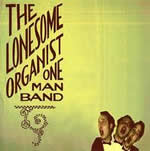
Although most record reviews benefit from creating a firm context for an artist’s work, there’s little in conventional music that prepares one for The Lonesome Organist, a.k.a. Jeremy Jacobsen. A genuine oddity in the Chicago music scene, for those who don’t know, the Organist is a talented multi-instrumentalist who one-ups Prince by playing everything at once, one man band-style. For those who have experienced this in person, the sight of Jacobsen playing drums, guitar, and piano while simultaneously singing is apparently quite a sight to behold. And while it’s unquestionably a good thing to have a musician tapping into long-forgotten styles of music and performance, the question remains: is it any good?
While it would undoubtedly improve the experience of Form and Follies to see Jacobsen performing (the tracks were recorded almost entirely live), there’s still a load of strange instrumentation and engagingly strange performance. Although the Vaudeville reference is an obvious and well-worn comparison, it’s apt, as Jacobsen sounds like a manic stage performer, eagerly picking up a handful of random instruments, improvising tunes to keep the restless crowd happy. When the scheme works, on tracks such as “Only If I Get You”, the result is like a delirious time-warp to a Times Square music hall, sad and lonely, slightly frightening, an aging singer who’s past his prime and knows it. The sentiment isn’t genuine, but it isn’t delivered ironically, either. It’s more akin to someone trying desperately to recreate real emotion, and failing.
There are also loose, faux-jazz instrumentals, made with everything from carnival organs to toy pianos and accordion. Nostalgic and disjointed, they resemble a robot trying to experience someone else’s memory of music, or an old 78 heard through a heavy sedative fog. All the elements are in place, but they connect in unexpected, misdirected ways. Jacobsen’s is a strange muse, and it’s difficult to decipher what he’s trying to communicate, or what we’re meant to feel. The music here isn’t weird enough to be truly “out there”, but it’s far too misguided to be emotionally involving. There’s certainly humor, and if Jacobsen’s intentions are somewhat murky, his ability to repeatedly engage the listener is strangely consistent. For lovers of Tom Waits’ mid-period, deconstructionist phase, there is much here that compares favorably. Much of the album is spent in a Waits-style swoony, faux-show tune atmosphere, a drunken entanglement of musical eras and styles. There’s even an SST-style punk dirge, “Who’s To Say Your Soul’s Not Carbon?”, full of guitar squalls and pounding drums.
There’s nothing remotely cohesive on Form and Follies, but this is often to its benefit; an entire album of any one style would be an interminable. Ultimately, the potential enjoyment of the music depends on your ability to absorb well-made ephemera. Hardly anything here constitutes a full song, in the classic sense, yet the record exerts an odd pull, a fascination. Ultimately, the record’s allure has less to do with the gimmickry of Jacobsen’s performance than his ear for oddness and unrelenting energy.
By Jason Dungan
|




 View all articles by Jason Dungan